- +86 15950329902
- [email protected]
- Need some help? [email protected]@dfyunlin.com

Leave Your Message
Choosing a Stuffed Toy manufacturer is not just a matter of comparing prices or browsing attractive product photos. Global buyers need to examine materials, stitching, sample consistency, production capacity, communication, and documented quality controls. A soft plush face can look perfect online. The seams underneath tell another story.
Joan Lawrence, a longtime toy-safety specialist and former senior vice president at The Toy Association, has emphasized safety across toy design and production. A practical paraphrase of her guidance is: “Safety belongs in the design process, not only at final inspection.” That principle matters when buyers assess factories, request material details, and review testing records. It also helps separate a polished sales presentation from a dependable manufacturing process.
This guide looks at manufacturers through a buyer’s lens: product quality, customization options, order flexibility, lead times, and the clarity of supplier communication. Ask for representative samples. Check whether embroidery, fabric texture, and filling match the approved version. Confirm how changes are recorded. Small details matter. A neat sample does not guarantee every production run will match it, and no shortlist is flawless. Buyers should verify claims directly and consider independent quality checks when appropriate. The manufacturers featured here offer starting points for comparison, not a substitute for careful sourcing. The best partner is the one whose capabilities, evidence, and working style fit your product and your customers.
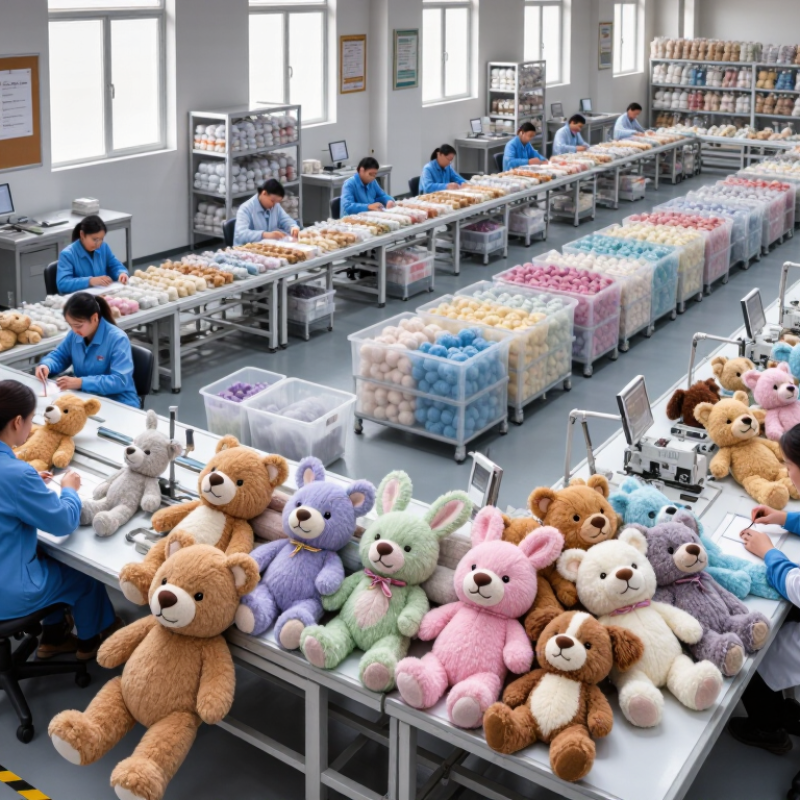
For global buyers in 2026, a stuffed toy manufacturer is more than a factory with sewing lines. It should turn a design brief into a repeatable product, with clear choices for fabric, filling, stitching, and size. Ask how it controls changes between samples and bulk orders. Small seams matter. A neat sample can still hide weak production controls.
Reliable partners document materials by lot, keep inspection records, and explain how they assess seams, small parts, colorfastness, and filling consistency. Requirements vary by destination and age group, so confirm applicable safety and labeling rules with qualified local specialists. Request recent test reports tied to the actual materials and construction, not a generic file. That is not enough. A report cannot replace routine checks on the production floor.
Capacity matters, but so do realistic lead times, minimum order quantities, packaging details, and a named contact who answers questions plainly. Ask for a pilot run, inspect random units, and compare them with the approved sample. Discuss defect handling before placing a large order. Even experienced teams miss things; a checklist may miss a crooked face or uneven filling. Look for a manufacturer willing to show its process, admit limits, and document corrective actions.
| Evaluation Area | What Global Buyers Should Assess | Relevant Evidence or Benchmark | Buyer Verification |
|---|---|---|---|
| Product safety and compliance | Whether the manufacturer can identify the toy’s destination-market requirements and support the required testing and documentation. | Requirements differ by market. Examples include ASTM F963 for toys sold in the United States, EN 71 for the European Union, and ISO 8124, an international toy-safety standards series. Applicable requirements depend on the product and destination. | Request reports for the specific product or representative materials, confirm the testing laboratory and report scope, and check that the documents match the intended market and product design. |
| Chemical and material controls | Controls for fabric, dyes, plastics, coatings, stuffing, and other components, including supplier traceability and restricted-substance management. | For the U.S. market, CPSIA requirements include limits on lead and certain phthalates in covered children’s products. EU REACH restrictions may also apply to substances in articles. | Ask for material specifications, applicable chemical test reports, a component list, and a process for rechecking materials when suppliers or formulations change. |
| Age grading and labeling | How the manufacturer considers the intended age, foreseeable use, small parts, warnings, and destination-market labeling. | Age grading and warning rules depend on the product and jurisdiction. In the U.S., children’s products subject to applicable rules may require tracking information; toy warnings and labels must be checked against the relevant regulations. | Review the proposed age grade, warning text, packaging artwork, and label placement before production. Confirm who is responsible for final regulatory review. |
| Quality management | Consistency of incoming materials, sewing, embroidery, stuffing, finishing, and final inspection. | ISO 9001 is a quality-management-system standard; it is not, by itself, proof that a particular toy meets toy-safety requirements. | Review quality procedures, inspection records, defect handling, corrective actions, and any current management-system certificate within its stated scope. |
| Construction and durability | Seam strength, attachment security, fabric performance, stuffing containment, and suitability for the intended age and use. | Relevant mechanical and physical safety tests are determined by the applicable toy-safety rules, product design, and age grade; a generic sample test may not cover every production change. | Approve a production-equivalent sample and agree on critical quality points, test methods, acceptance criteria, and change-control procedures. |
| Traceability and change control | Ability to link finished goods to production dates, material lots, suppliers, and inspection or test records. | Traceability details and recordkeeping obligations vary by market and product. U.S. children’s-product tracking-label rules apply where required. | Check sample batch records and confirm that the manufacturer will notify the buyer before changes to materials, factories, processes, or product specifications. |
| Production capacity and lead times | Available production capacity, seasonal planning, sampling stages, and the impact of materials or approvals on delivery schedules. | Capacity and lead times are factory- and order-specific; no single production volume or timeline is a universal industry benchmark. | Request a written schedule covering sample approval, material procurement, production, inspection, and shipment, with assumptions and delay-notification steps. |
| Order terms and cost transparency | Clarity on minimum order quantities, tooling or sample charges, packaging, payment terms, and what is included in a quotation. | Minimum order quantities and pricing vary with design complexity, materials, production planning, and order size. | Compare like-for-like quotations and confirm specifications, currencies, delivery terms, payment milestones, and responsibility for testing and shipping costs. |
| Ethical and environmental due diligence | Workplace practices, subcontracting controls, material sourcing, waste management, and claims about recycled or preferred materials. | Audit schemes and environmental certifications differ in scope and do not automatically establish compliance with every buyer policy or local law. | Check the audit date, facility and worker coverage, findings and corrective actions; request supporting documentation for material and environmental claims. |
| Packaging and international shipping | Packaging protection, carton data, shipping documentation, and readiness for the buyer’s import and distribution requirements. | Import documentation and labeling depend on the destination, product, and agreed delivery terms. Packaging requirements should be confirmed for each market and sales channel. | Review carton dimensions and weights, packing lists, product labels, shipping documents, and the agreed Incoterms® rule and named place. |
| Communication and after-sales support | Responsiveness during sampling and production, document management, issue escalation, and support for complaints or corrective actions. | Service levels are contractual or buyer-defined rather than universal industry standards. | Agree on named contacts, response expectations, approval checkpoints, record retention, and a documented process for handling defects or recalls. |
Note: This is a practical 2026 buyer-evaluation framework, not a ranked list of manufacturers. Regulatory requirements can vary by product, age grade, and destination; confirm current obligations with the relevant authorities or a qualified compliance professional.