- +86 15950329902
- [email protected]
- Need some help? [email protected]@dfyunlin.com

Leave Your Message
A dog bed is more than a soft place to nap. The right design can help a dog settle comfortably, stay cool, or feel sheltered. Yet no single style suits every dog. A senior Labrador who struggles to rise may need different support from a small terrier that curls beneath a blanket. Even within one household, preferences can change with age, season, or health.
This guide compares popular types of dog beds, including orthopedic, bolster, cave-style, cooling, elevated, and washable designs. It explains how each one feels in everyday use, from a raised mesh surface that allows air beneath the body to a cushioned rim that gives a dog somewhere to rest its chin. Small details matter. Check the bed’s dimensions, cover care instructions, and the firmness of its filling. A plush surface may look inviting but flatten quickly; a firm mattress may feel supportive yet put off a dog that prefers to burrow. Labels alone are not enough.
Think about your dog’s sleeping posture, mobility, coat, and usual resting spots before choosing. Watch where your dog settles at home. That can be revealing. Product descriptions offer useful clues, but they cannot predict every dog’s response, and reported benefits are not guarantees. If discomfort or difficulty getting up persists, a bed is not a substitute for veterinary advice. The best choice is practical, cleanable, and comfortable for the dog who will actually use it—not merely attractive in a product photo.
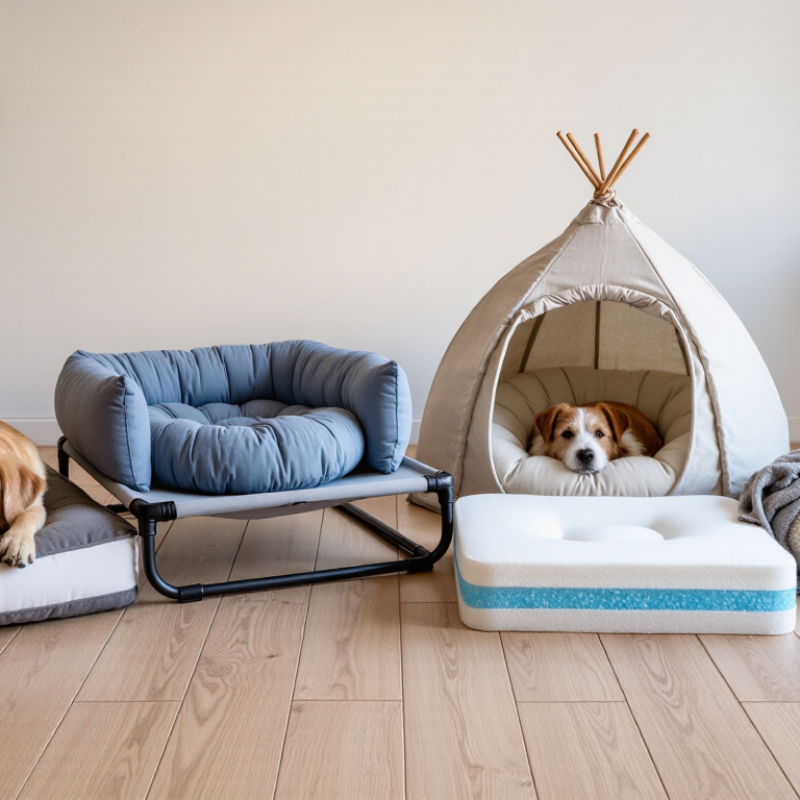
Dog beds differ most in how their shape guides posture and how their structure distributes weight. A flat mattress gives sprawlers room to stretch, while a bolster bed adds a raised edge for dogs that curl or rest their heads. Donut beds provide a soft, enclosed rim; cave beds add a fabric roof for dogs that seek cover. Raised cot-style beds keep the sleeper above the floor, allowing air to move beneath the surface. Small details matter: a slippery base can shift on hardwood, and deep sides may obstruct an older dog’s entry. Shape alone tells only part of the story.
Support comes from the filling, its thickness, and how well it holds its shape under pressure. Firm foam may suit a heavier dog better than loose stuffing, which can bunch into uneven pockets. Still, a “supportive” label does not prove a bed fits a particular dog. Watch where the hips and shoulders settle, and check whether the dog can rise without struggling. The distinction can be fuzzy. Grand View Research estimated the global pet furniture market at about $3.2 billion in 2023, reflecting demand for products such as beds, but market growth does not establish health benefits. The American Pet Products Association’s 2023–2024 National Pet Owners Survey estimated that 66% of U.S. households owned a pet. These figures describe a large market, not a clinical standard. Dogs with persistent pain or mobility changes need veterinary guidance, not a new cushion alone.
| Bed Type | Typical Shape and Structure | Support and Feel | Often Suited To | Practical Considerations |
|---|---|---|---|---|
| Bolster Bed | Usually rectangular or oval, with raised padded sides and an open sleeping area. | The cushioned rim gives dogs a surface to rest their head against; the base provides a separate resting area. | Dogs that like to curl up, lean against a side, or rest their head on a raised edge. | Check that the sleeping area is large enough for the dog to stretch out. Raised sides may be harder for some dogs to climb over. |
| Donut or Cuddler Bed | Round or oval, with a soft, raised perimeter surrounding a recessed center. | Creates a soft, nest-like space with a cushioned edge for curling and head support. | Small and medium dogs, or dogs that prefer curling into a compact sleeping position. | Choose a size that allows the dog to lie comfortably without being squeezed by the rim. Deep rims can be less accessible for dogs with limited mobility. |
| Flat Mattress Bed | A flat rectangular cushion, often with a fabric cover and foam, fiber, or other fill. | Provides a broad, even surface; firmness and cushioning depend on the filling and thickness. | Dogs that stretch out, larger dogs, and households that need a simple bed for a crate or room. | Look for a mattress that stays level under the dog’s weight. A removable, washable cover can make routine cleaning easier. |
| Orthopedic Foam Bed | Typically a thick mattress, sometimes with shaped or layered foam and a supportive base. | Designed to distribute body weight across a cushioned surface; foam density and construction affect how it feels and holds its shape. | Older dogs or dogs that may benefit from a more substantial, supportive sleeping surface. | “Orthopedic” does not guarantee a particular level of support. Compare the bed’s construction, thickness, and firmness, and consult a veterinarian about joint or pain concerns. |
| Elevated Bed | A taut fabric sleeping surface held above the floor by a rigid frame, commonly with open sides. | Offers a firm, suspended surface rather than a thick cushion; airflow can pass beneath the bed. | Dogs that prefer a firmer surface, or settings where keeping the sleeping surface off the floor is useful. | Check frame stability, weight capacity, and fabric tension. The raised height may not suit every dog, especially one that struggles to step up. |
| Crate or Kennel Pad | A slim, rectangular pad sized to fit inside a crate or kennel. | Adds cushioning over a hard crate floor; support varies with the pad’s filling and thickness. | Dogs that sleep or rest in a crate, and owners looking for a simple, space-efficient bed. | Measure the crate interior and leave enough room for the door to close. For dogs that chew fabric, choose materials and construction with safety in mind. |
| Cooling Bed | May be a flat mat or a cushioned bed made with a cooling surface or heat-dissipating materials. | Designed to feel cooler to the touch or help disperse heat; it is not a substitute for shade, water, or a cool environment. | Dogs that seek cool resting spots, particularly in warm indoor conditions. | Follow the care instructions and inspect the surface regularly. Never rely on a cooling bed alone to prevent heat stress. |
| Heated Bed | A padded bed or mat containing a low-level heating element, or a self-warming layer that reflects body heat. | Provides gentle warmth rather than a distinct shape of support; cushioning depends on the bed’s base. | Dogs that seek warm resting places, when the product is appropriate for the dog and used as directed. | Use only products designed for pets and follow all electrical and temperature instructions. Check the dog can move away from the warm area freely. |
Selection tip: Match the bed to the dog’s sleeping position, body size, mobility, and preferred firmness. Bed features vary by design, so check measurements, materials, cleaning instructions, and the manufacturer’s care guidance.